

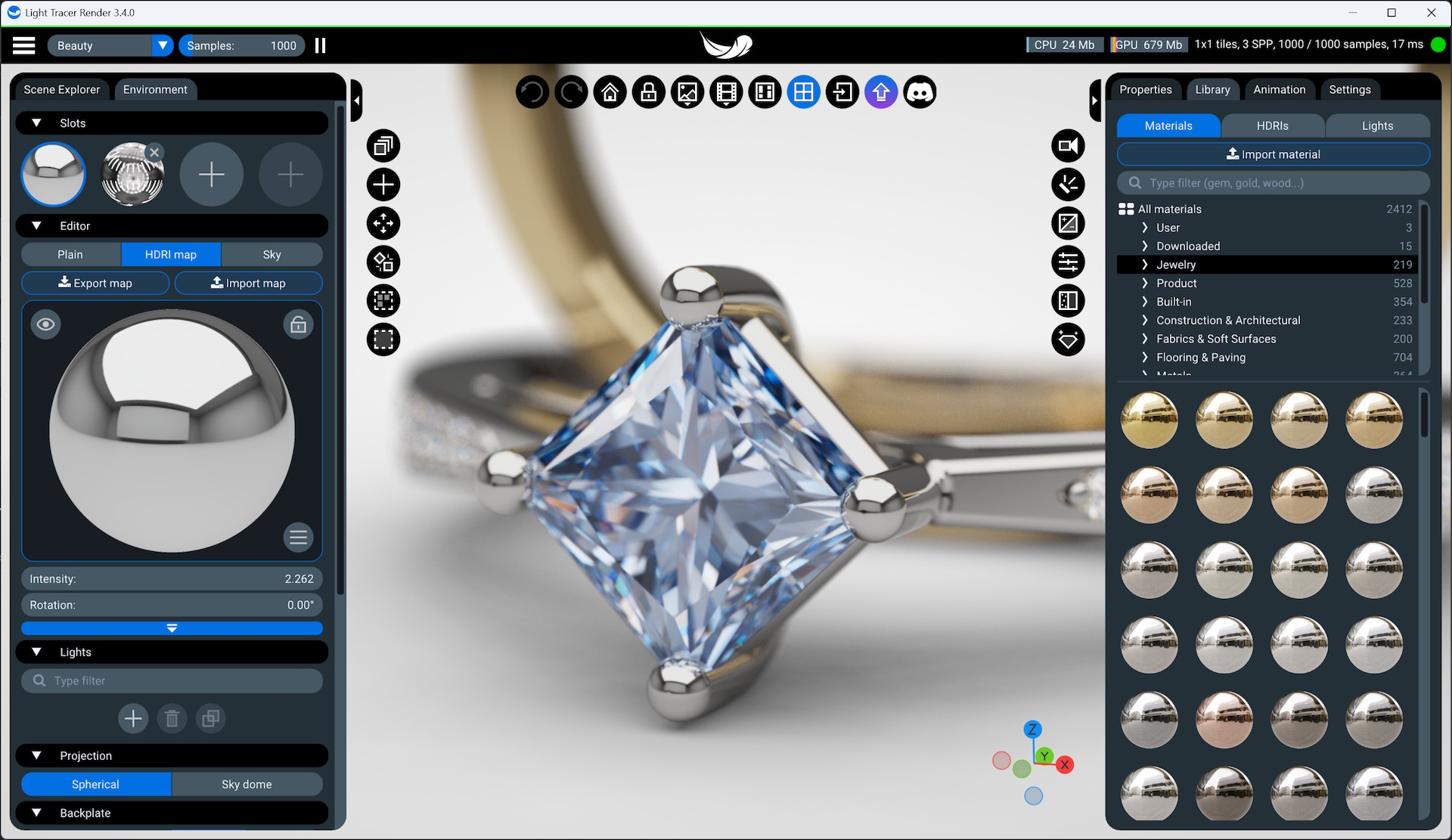
Light Tracer Render is an interactive, physically based renderer for Windows, macOS, and WebGPU-capable browsers. It focuses on jewelry and product visualization, with a workflow built around immediate visual feedback as you edit materials, lighting, and camera settings.
We started the project in 2019 to explore interactive path tracing in the browser using WebAssembly and WebGL2. Since then, it has grown into a production tool for still images and animation, while retaining the original focus on rendering speed and usability.
We develop our own GPU rendering engine, with shared shader sources across the desktop and browser versions. Our shader pipeline translates GLSL through SPIR-V to WGSL for WebGPU, carrying the rendering implementation across platforms. On desktop, the engine also supports hardware-accelerated ray tracing.
Much of the work is about making difficult light transport usable interactively. The renderer combines camera and light tracing for caustics and complex indirect illumination. A specialized gemstone mode evaluates multiple wavelengths in its initial interactive frames, so dispersion remains visible while adjusting the scene.
For everyday work, Light Tracer includes CAD and mesh import, material and HDRI libraries, interactive lighting tools, and animation of objects, cameras, and environments. Light Space extends this workflow with scene sharing and embeddable interactive viewers, with rendering performed locally on the viewer’s device.
Our aim is to make physically based rendering practical as an interactive tool: use the available hardware efficiently, keep the workflow responsive, and let people see the effect of their decisions as they work.
Light Tracer Render is a commercial product with subscription and perpetual licenses. A free 14-day trial is available.